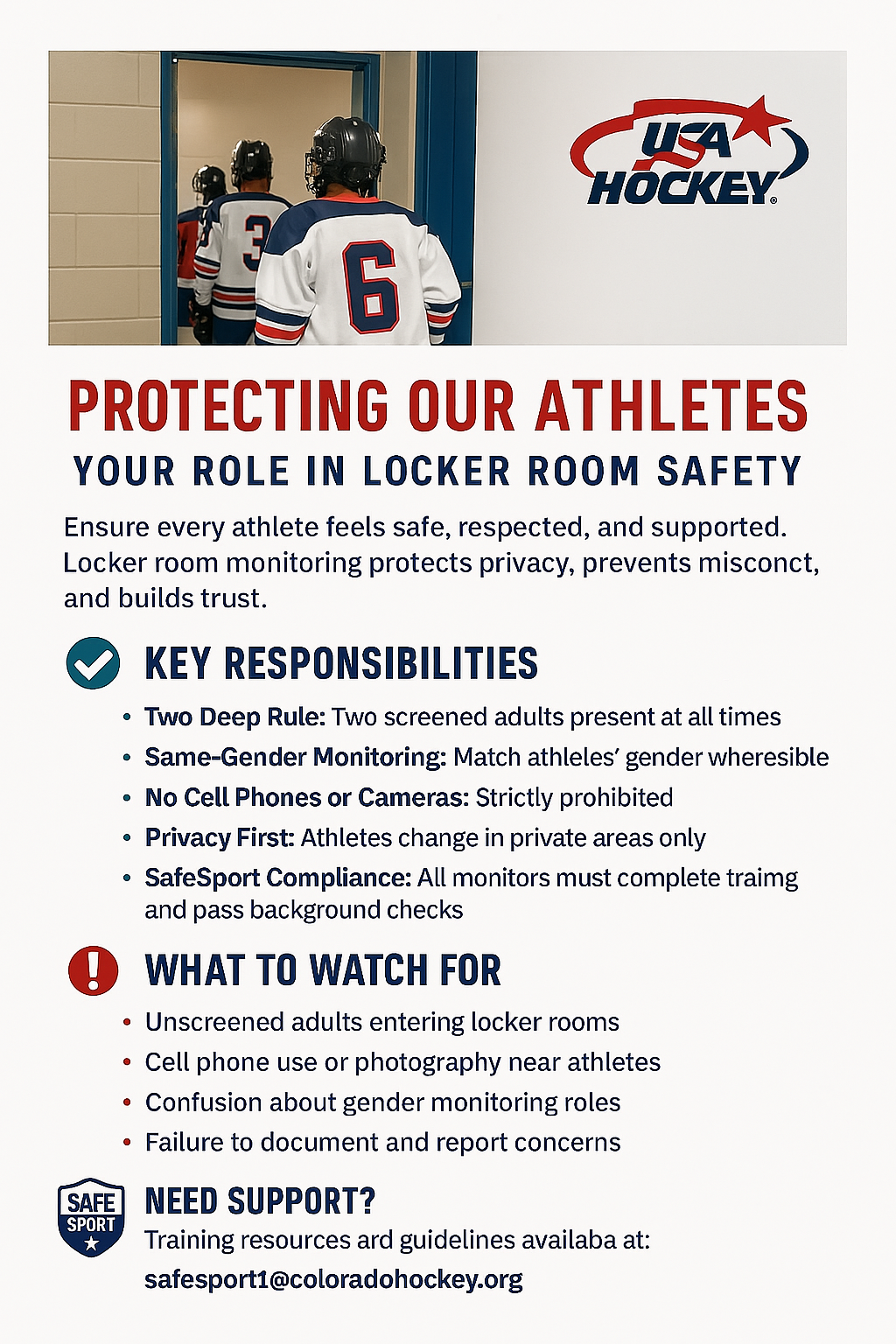


Locker Room Policy
LOCKER ROOM GUIDLINES
BHC wants all players to be safe on and off the ice. BHC is also aware that the locker rooms provide a place where abuse and misconduct can occur. Players are particularly vulnerable in locker rooms due to various stages of dress and undress and because players are less supervised. Player to player issues such as sexual abuse, bullying, hazing and harassment often occur when players are not supervised.
Adherence to Locker Room Guidelines can reduce opportunities for misconduct and abuse. It will also allow for a fun and safe place for players while still holding to hockey traditions. BHC requires that players and coaches follow USA Hockey and CAHA SafeSport Program guidelines at all times.
BHC has its own Locker Room Policy designed specifically for our club and facility.
BHC requires all players and coaches to report to the Hockey Director and/or SafeSport Coordinator any and all misconduct, abuse, or violations immediately.
Boulder Hockey Club Locker Room Policy:
This policy is specific to the Blue Sport Stable and is published to the parents of all Minor Athletes, as required by USA Hockey.
Youth players are particularly vulnerable in locker rooms, changing areas, and restrooms because of stages of dress and undress and because they are less supervised than at other times. Athlete-to-athlete problems, sexual abuse, bullying, harassment, hazing, often occur when a responsible adult is not in a position to observe. Adherence to this policy enhances privacy, significantly reduces the likelihood of misconduct, and ensures an adult is present to confer with a player who may have been injured.
Supervision and Monitoring:
At least two responsible, screened, SafeSport-trained adult (18 or older, a coach, manager, or approved volunteer) must be present and actively monitoring the locker room at all times during every team event. Two monitors are strongly preferred and BHC requires two wherever staffing permits.
- Preferred practice is monitors inside the locker room while participants are present. At a minimum, a monitor must be in the immediate vicinity outside the door, within arm’s length of the door and close enough to hear inside and must regularly and frequently enter to monitor activity.
- If a monitor is inside the room, two monitors should be used, because a second monitor helps protect both from allegations of impropriety.
- The monitor ensures only participants (coaches and players), approved team personnel, and, for 8U only, family members are permitted in the locker room.
- Doors may be left open only where adequate privacy is still possible.
- Team personnel must secure the locker room during times when players are on the ice.
- If a Minor Athlete goes to a locker room during practice or a game and does not return promptly, an Adult Participant, two, if possible, must check on the player’s whereabouts.
- Every responsible adult who monitors the locker room must have completed SafeSport training and a background check.
Accountability. BHC staff, division directors, and team managers are responsible for working with teams and coaches to ensure locker room monitors are always in place. For each team, the head coach and team administrators are responsible for compliance. A coach or administrator who fails to take appropriate steps to ensure this policy is followed, and any participant or parent who otherwise violates it, is subject to disciplinary action; CAHA may also fine BHC.
Use & Rules:
- There shall be no one-on-one interaction between an Adult Participant and a Minor Athlete in any locker room or changing area unless a Policy Exception applies.
- A Minor Athlete who is a teammate of an Adult Participant more than four years older may share a locker room but must not be alone in it unless the interaction is Observable and Interruptible.
- An Adult Participant may shower with a Minor Athlete only if they are teammates and the Close-in-Age exception applies.
- A parent or guardian may request that their Minor Athlete not change or shower with an Adult Participant during In-Program Contact. BHC will honor that request.
- A private or semi-private area, a bathroom stall or separate bathroom, must be available for Minor Athletes to change or undress. Team managers are responsible for identifying that space at every facility the team uses.
- Coaches must always have at least a base layer of clothing on while changing, or must use a private area. An Adult Participant must not intentionally or recklessly expose breasts, buttocks, groin, or genitals to a Minor Athlete. Coaches should have a separate place to change and shower and are never to be nude among players.
- Coaches should visit the locker room periodically before and after practices while their teams use these rooms. Putting skates on in the locker room is a good way to monitor activity.
- If a player is the only person in a locker room and a coach needs to speak with them, the door must remain open, or another coach or parent must be present.
Minimum Attire:
All players must wear minimum attire in the locker room at all times. Players should arrive at the rink already wearing their base layer, shorts and a T-shirt, compression shorts and shirt, or sports bra, under street clothes, in good condition with no holes or tears. A player not wearing a base layer must use a restroom to change into it before entering the locker room. This standard applies to practices as well as games.
For the purposes of the coaches’ clothing rule, sports bras and underwear are not considered base layers.
Cell Phones and Recording Devices:
Cell phones and other mobile devices with recording capability, voice recording, still cameras, and video cameras, increase the risk of abuse and misconduct.
- The use of any device’s recording capability in locker rooms, changing areas, or similar spaces is prohibited.
- Immediately on entering the locker room, every player must put away their phone. Use of a cell phone is prohibited within the locker room.
- Exception, music. If the coach approves, a single player may use a phone to play age-appropriate, non-explicit music. The music must run from a playlist and the phone must be placed next to the speaker; the player should not handle the phone except to start and stop the music.
- Exception, media and championship celebrations. Photography or recording may be permitted only where BHC approves the specific instance, parent/guardian consent is obtained for every Minor Athlete involved, two or more Adult Participants are present, and everyone in the room is fully clothed and has been advised that photographs or recordings are being taken.
Player Conduct in Locker Rooms and Showers:
- Locker rooms and showers are used by same-age peers where possible. No mixed-gender use. Opposite-sex players are provided separate changing and showering facilities.
- Showers are for showering only. No horseplay, urinating on others, physical contact, sexual activity, or other misconduct.
- No bullying, hazing, harassment, fighting, or locker boxing.
- Players may not touch another player’s genital area, or their own in a way that makes others uncomfortable.
- Recording devices of any kind are prohibited.
- No pornographic material in the locker room or at any BHC activity anywhere.
- No drugs, alcohol, smoking, vaping, or other illegal substances.
- Nudity is kept to a minimum; after showering, players dress quickly.
- No physical contact between players of a sexual nature.
- The locker room is not a place to criticize or humiliate teammates. No displays of affection.
- No acts of self-harm. Any indication of self-harm must be reported immediately to the head coach and the Executive Director, who will involve the player’s parents and appropriate professional resources.
- Showering and changing at the facility are optional.
Co-Ed Locker Rooms
Hockey teams often include players of different genders. The privacy rights of all players must be respected, and it is not acceptable under USA Hockey’s Sexual Misconduct Policy for anyone to observe a player of another gender dressing or undressing.
BHC recognizes that:
- this issue must be dealt with, and favoring one group over another can produce legal consequences;
- the ideal of two separate dressing rooms is not always possible in a given arena;
- the issue grows more visible as girls’ and women’s participation grows; and
- it affects players, coaches, and officials alike.
Approved approaches (BHC uses whichever the facility and team make workable):
- Minimum attire. All players arrive already wearing base layers under street clothes so no player of one gender can see a player of another gender in a state of dress or undress. A player without the required attire is directed to a restroom or private area to change first.
- Separate locker rooms. Players of different genders change in separate, supervised locker rooms, then gather in one designated room roughly 10–15 minutes before the game or practice for the coach to address the team. A player not fully dressed when the coach arrives goes to a separate room or bathroom to finish.
- Alternate use of one locker room. Players of one gender dress while the others wait outside; then the groups switch. No coaching occurs until all players are together. Taking turns is a means of reasonable accommodation, neither group should be favored, and one group should not always be the group that waits.
Monitoring. Where possible, when players of different genders are together in the locker room there should be two screened, SafeSport-trained adults in the room. BHC also accepts one monitor immediately outside the room checking in regularly, but two is always preferable. Where practical, monitors should be of the same gender as the players they supervise.
It is forbidden for families, players, coaches, managers, or volunteers to observe a player of another gender, or any minor, while dressing or undressing. Violations are subject to discipline.
Officials' Locker Rooms:
Officials’ rooms are usually set apart from team rooms and may be shared by officials of different genders and ages. Officials should never assume other officials are comfortable with the same arrangement they are. Where separate rooms are not available and officials of different genders are present: officials of one gender dress while the others step out; then they switch; then both may be in the room to conduct the pre-game meeting. The same procedure applies after the game.
Where minor-age officials work with or share a room with adult officials, adult officials must limit one-on-one interactions by inviting a parent, guardian, or other Adult Participant into the room; asking another official to wait before leaving; and/or leaving the door open so the interaction is Observable and Interruptible while another Adult Participant is aware of it. Supervisors and assignors of officials must always avoid one-on-one interactions with any official unless Observable and Interruptible.